
Last updated November 15, 2026
 Wrought iron
 Wood & steel frame
 Farm & ranch
 Sliding driveway gates
 LiftMaster operators
Free on-site gate assessment - hinges, posts, and your LiftMaster or Nice gate operator checked before anything is quoted
The assessment is free and the quote is the invoice.
Get your free estimateGate Repair Maintenance Checklist for Vacaville Homeowners
A gate that passed a visual inspection in April can seize by July. That’s the counterintuitive part of gate ownership in Vacaville: the biggest threat to your operator and hardware isn’t rain or a tree limb, it’s the dry heat and dust of a Central Valley summer working quietly on parts you never look at. Marginal lubrication dries out, grit migrates into rollers, and a system that ran quietly in spring starts grinding by midsummer. Most homeowners find out when the gate stops opening. This guide gives you a season-anchored checklist built for Vacaville conditions, tells you which tasks you can safely handle and which belong to a technician, and covers the sensor and hard-water checks almost everyone skips.
Quick Answer
A Vacaville homeowner should run a monthly visual and safety check, a quarterly lubrication and sensor-cleaning pass keyed to the dry season, and an annual deep inspection of hardware, wiring and the operator before summer heat sets in. Clean your photo eyes and loop area monthly, use heat-rated lubricant on hinges and rollers, and leave spring-free but high-voltage operator internals, wiring and safety-edge adjustments to a technician. Filters and eyes get attention; lubrication and dust control are what actually shorten gate life in Vacaville.
Styles & brands we work with
- Wrought iron
- Wood & steel frame
- Farm & ranch
- Sliding driveway gates
- LiftMaster operators
Table of Contents
- Why Vacaville Conditions Break Gates Faster Than Generic Checklists Suggest
- The Monthly Checklist: What to Look At Every Month
- The Quarterly Checklist: Lubrication and Dust Control
- Hard Water and Mineral Scaling on Hinges and Rollers
- Inspecting Loop Detectors and Photo Eye Sensors
- The Annual Deep Inspection Before Summer
- Five Things You Can Do Yourself vs. Six That Need a Technician
- Common Mistakes to Avoid
Why Vacaville Conditions Break Gates Faster Than Generic Checklists Suggest
National maintenance checklists are written for an average climate that doesn’t exist. Vacaville sits in a valley where summer afternoons routinely push past 100°F, the ground goes bone dry for months, and wind lifts fine dust off bare soil and driveways straight into moving parts. That combination is harder on a gate than a wetter, cooler climate, and it fails in ways a spring cleaning never catches.
Three local stressors drive most of the premature wear we see in Vacaville:
- Dry heat. Lubricant that’s rated for mild temperatures cooks off surfaces in the heat, leaving rollers, hinges and pivot points running metal-on-metal. Grinding starts small and accelerates fast.
- Valley dust. Fine particulate settles into the operator housing vents, the track on a slide gate, and the face of every sensor. Dust on a photo eye is one of the most common reasons a gate “randomly” reverses.
- Hard water and minerals. Irrigation overspray and hose water carry dissolved minerals that deposit on hinges, rollers and the rail. Left alone, those deposits harden and start to bind the hardware.
None of this is dramatic. It’s the slow, steady kind of wear that hides until the gate quits. The fix is a checklist tuned to Vacaville’s rhythms instead of a copy-paste from a national site, which is what the rest of this guide gives you.
The Monthly Checklist: What to Look At Every Month
Once a month, walk the whole gate with fresh eyes and don’t touch anything yet. The goal is to catch drift before it becomes a breakdown. Ten minutes is enough if you know what you’re looking for.
- Open and close the gate and listen. A healthy gate sounds consistent. New squeaks, rattles or a slower start hint at a lubrication or alignment issue starting up.
- Look at the photo eyes. Find the two small lenses on either side of the opening and check them for dust, cobwebs and grime. A dirty lens is the number one cause of phantom reversing.
- Check the loop area for debris. If you have a driveway loop, sweep leaves and dirt off the area above it. Heavy debris sitting on top of the loop can throw off detection.
- Scan the track or rail. On a slide gate, look for buildup or a small obstruction that could catch a roller. On a swing gate, look at the ground where the leaf travels.
- Test the safety reverse. Put an object in the gate’s path while it closes and confirm it reverses. This is a safety check, not a repair, and it should work every single time.
- Eyeball the hardware. Look for rust spots, loose bolts, and any white or chalky mineral film on hinges and rollers (more on that below).
Keep notes of anything that changes month to month. A noise that’s getting louder is a pattern, and patterns tell a technician where to look when you eventually call. If something stops working entirely, our gate repair team can look at it and tell you what’s actually failing.
The Quarterly Checklist: Lubrication and Dust Control
This is where Vacaville’s climate changes the standard advice. Most guides tell you to “lubricate twice a year.” In valley heat, twice a year isn’t enough for exposed hardware, and the wrong product is worse than none. A quarterly pass synced to the seasons does far more for gate life here than any annual ritual.
Which lubricants fail in high heat. Light household oils and general-purpose spray lubes thin out and evaporate off surfaces when the metal gets hot, leaving a dry film and grit. Grease that isn’t rated for heat can soften and turn into a dust magnet. You want products rated for the temperature range a Central Valley summer actually reaches, applied sparingly on hinges, pivot points and roller axles.
Dust control matters as much as lubrication. A quarterly pass should include blowing or wiping dust off the operator housing vents and out of the track. Grit mixed with lubricant forms an abrasive paste that wears rollers faster than running dry.
Time it to the seasons. A simple rule for Vacaville:
- Early spring: fresh lubrication before the heat arrives, dust cleared from everything.
- Early summer: recheck hardware as the first hot weeks hit; this is when marginal lube shows itself.
- Early fall: clean out the dust that accumulated over the dry months and relubricate.
- Early winter: a light pass before the cooler, wetter months, plus a look at any hardware loosened by months of heat cycling.
Operator brand matters here. Whether you run a Mighty Mule, an Elite, a Ghost Controls unit or a commercial DoorKing system, the manufacturer’s recommended lubrication points and intervals are the baseline, and local conditions may push you to do it more often.
Hard Water and Mineral Scaling on Hinges and Rollers
Hard water leaves mineral deposits that look harmless until they start binding hardware. In Vacaville, irrigation overspray and hose water near the gate carry dissolved minerals that dry onto hinges, rollers and the rail as a powdery or chalky film. That film builds up layer by layer and quietly narrows the clearance your hardware needs to move freely.
How to spot it early. Look for white or gray crust at pivot points, dull films on roller axles, and gate hardware that feels stiff at the start of travel. If a roller used to spin free and now feels gritty or tight, minerals and dust are the likely culprit.
Why it matters. Once scaling gets into a roller axle or hinge pin, it acts like sandpaper. The hardware starts binding, the operator works harder, and you end up replacing parts that would have lasted years with a little attention.
What you can do. Wipe down exposed hardware after irrigation overspray hits it, and don’t aim sprinklers or hoses directly at hinges, rollers or the rail. Keep plants and irrigation heads back from the gate path. A gentle wipe of visible mineral film is safe. Actually disassembling a roller or hinge to clean it is a technician job, especially on a powered gate where the panel is heavy and can shift.
If scaling has already frozen hardware, don’t force it. Binding hardware under an electric operator stresses the motor and control board, and that’s a far bigger repair than a stiff hinge. For that we’d point you toward electric gate repair rather than a screwdriver and brute force.
Inspecting Loop Detectors and Photo Eye Sensors
Loop detectors and photo eyes are the most skipped maintenance item on any gate, and in dusty Vacaville they’re also the most likely to cause mystery problems. A gate that reverses for no reason or refuses to close usually has a dirty lens or a debris-covered loop behind it.
Photo eyes. These are the paired lenses across the opening that tell the operator the path is clear. Dust, spider webs and grime block the beam and the operator reads a blocked path. Check them monthly, wipe the lens gently, and confirm the small indicator light (if the unit has one) is steady. Realign only if a lens has clearly been knocked out of aim by a bump.
Loop detectors. The loop is wire buried under the drive surface that senses a vehicle. Leaves, dirt and standing debris sitting on top of it can confuse detection. Keep the loop area swept and clear. If the gate stops detecting a car that’s sitting right on the loop, the loop or its wiring likely needs a technician, not homeowners digging at the driveway.
A quick sensor test routine:
- Wipe both photo eye lenses with a clean, dry cloth.
- Sweep the loop area and the gate path clear of debris.
- Walk through the gate opening during a close cycle and confirm it reverses.
- Drive slowly onto the loop and confirm the gate responds.
If a sensor won’t behave after cleaning, don’t tape over it or bypass it. Those devices exist to stop a heavy gate from closing on a person or a car. A sensor that stays faulty is a technician job and a safety issue worth taking seriously.
The Annual Deep Inspection Before Summer
The single best time to book a professional inspection in Vacaville is late spring, before the 100°F weeks arrive. That’s when a marginal system still has room to be corrected before the heat stress finishes it off. An annual deep inspection covers the things a homeowner can’t see or shouldn’t touch.
What a professional annual inspection covers:
- Operator internals. Control board, motor, capacitors and the housing around them, cleared of dust and checked for heat wear.
- Wiring and power connections. Loose or aging connections at the operator, in conduit, and at the safety edges.
- Safety edge and reverse function. Confirming every safety device works as designed, not just the photo eyes.
- Structural hardware. Hinge mounting, post stability, and the alignment of the gate leaf or slide panel.
- Battery backup and power. On operators that use a backup battery, checking condition before summer loads the system.
We work across the full range of operator brands because a deep inspection is brand-specific. LiftMaster, FAAC, BFT, Linear, Viking, Ghost Controls, DoorKing, Elite and Mighty Mule each have their own quirks in the control board, the sensors and the mechanical limits. A generic handyman can’t tell you whether the slowdown you’re hearing is normal for your operator or the first sign of a failing motor; we can.
Book the inspection once a year, ideally before June. If you notice problems between inspections, don’t wait for the annual visit. Call us and we’ll come look.
Five Things You Can Do Yourself vs. Six That Need a Technician
The line between owner-safe maintenance and technician work isn’t about difficulty, it’s about danger and warranty. Automation and access control are exactly where a small mistake gets expensive. Here’s where the line sits.
Five tasks a homeowner can safely do:
- Wipe dust and cobwebs off photo eye lenses and the operator housing vents.
- Sweep debris off the loop area and the gate path.
- Visual checks for rust, mineral film, loose bolts and misalignment, without touching the hardware.
- Applying heat-rated lubricant to exposed hinges, pivot points and roller axles, sparingly.
- Testing the safety reverse and photo eyes, and keeping notes on anything that changes.
Six tasks that need a technician:
- Opening the operator housing to work on the control board, motor or wiring.
- Diagnosing a gate that won’t move, reverses suddenly, or runs hot.
- Adjusting or replacing safety edges, photo eyes that won’t align, or loop wiring.
- Disassembling and cleaning frozen hinges or rollers, or replacing worn hardware.
- Any work on the power run, voltage, or an operator that trips a breaker.
- Aligning a heavy swing or slide panel that has shifted.
The reason to draw the line here is warranty. Most operator makers void the warranty when the housing is opened and internals are touched outside of trained service, so a well-intentioned DIY repair on a Mighty Mule or Linear can cost you coverage on a part that later fails. Access control panels and 240V connections carry real shock risk, and a heavy gate leaf under a running operator can crush fingers or hands. Our technicians have up to 10 years of experience working on these systems, and we’d rather tell you honestly that a job is a technician job. If something on the second list is failing, contact us.
Common Mistakes to Avoid
- Using the wrong lubricant. Light sprays and general-purpose oils cook off in Vacaville heat and leave metal dry. Use a product rated for the temperature range a valley summer actually reaches, applied sparingly.
- Skipping the sensor cleaning. Most “random reversing” in a dusty valley town traces back to a dirty photo eye or a debris-covered loop. Wipe and sweep monthly.
- Ignoring mineral film. That chalky deposit on hinges and rollers is the start of a frozen joint. Wipe it off the exposed hardware before it binds.
- Lubricating over grit. Adding lube without cleaning the track and rollers first turns fine dust into an abrasive paste. Clean, then lubricate.
- Bypassing a safety sensor. Taping over a photo eye or disabling a safety edge is dangerous and ineffective. A faulty sensor is a technician call.
- Forcing a binding gate to open. When hardware binds, the operator works harder and burns out controls and motors. Don’t force it; get it looked at.
- Scheduling the inspection too late. Booking a deep inspection after the first hot weeks means the heat has already found every marginal part. Get in before summer in Vacaville.
See the difference
 Before
 After
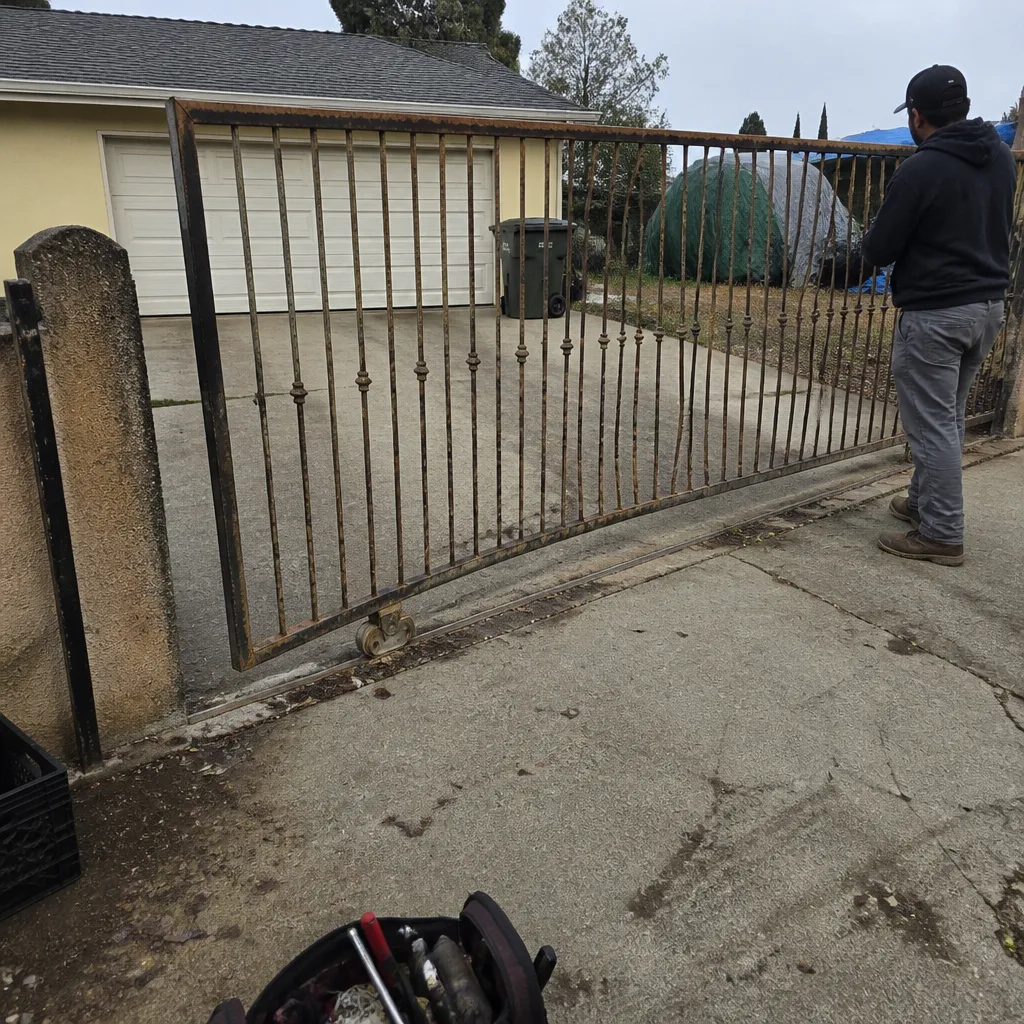 Before
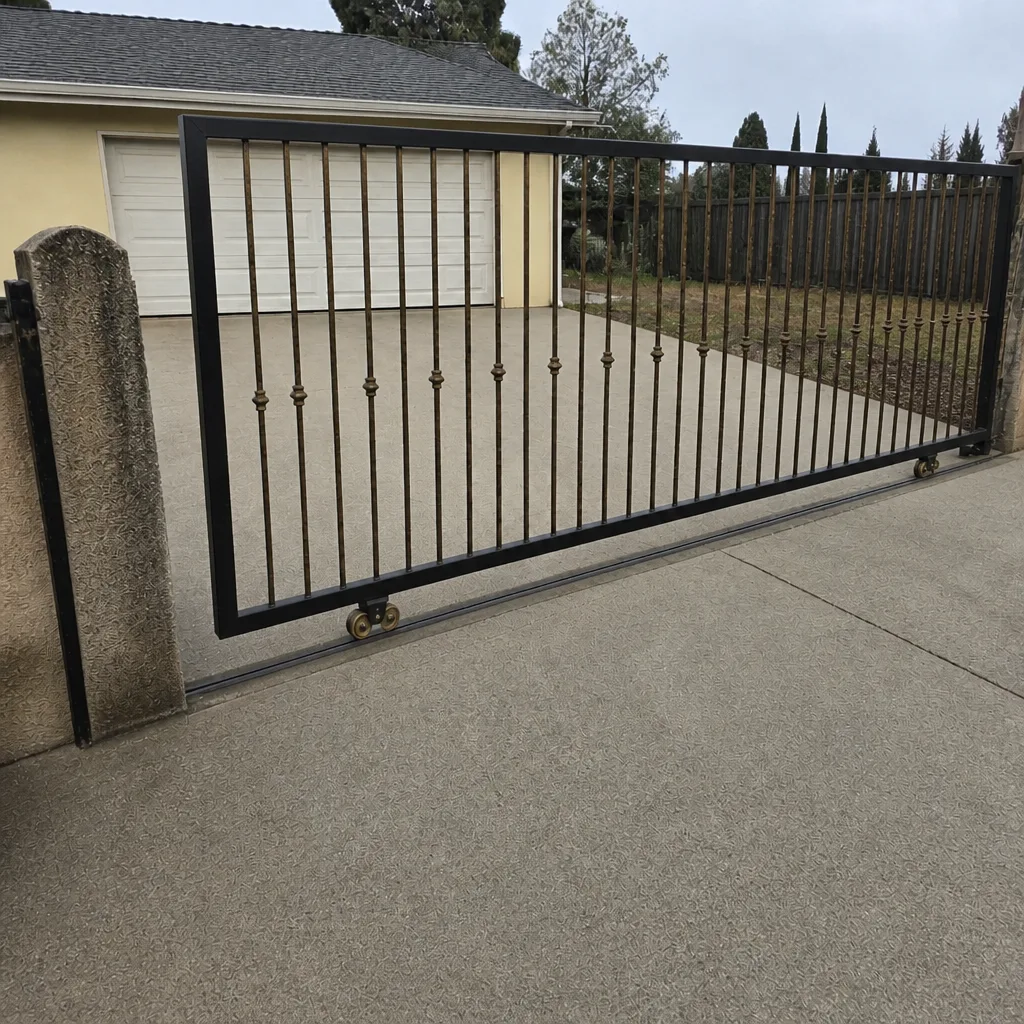 After
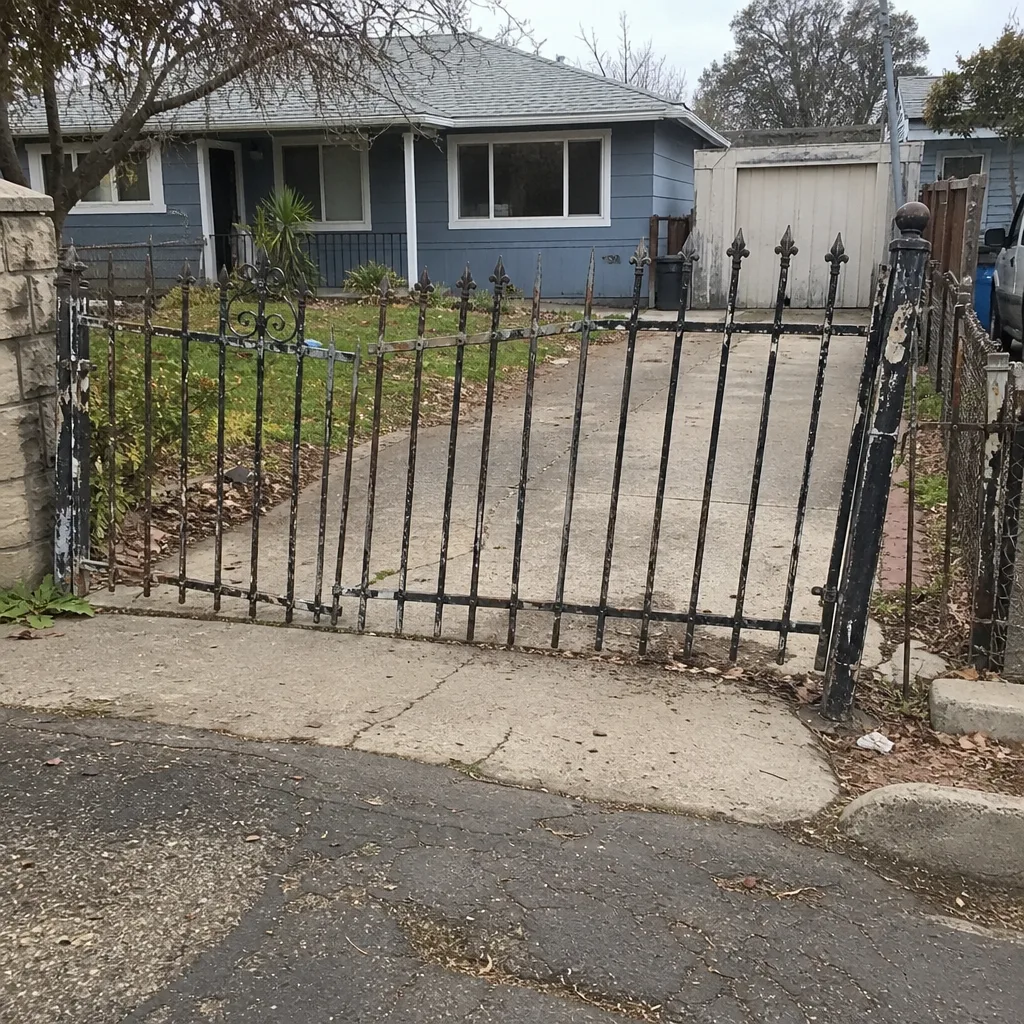 Before
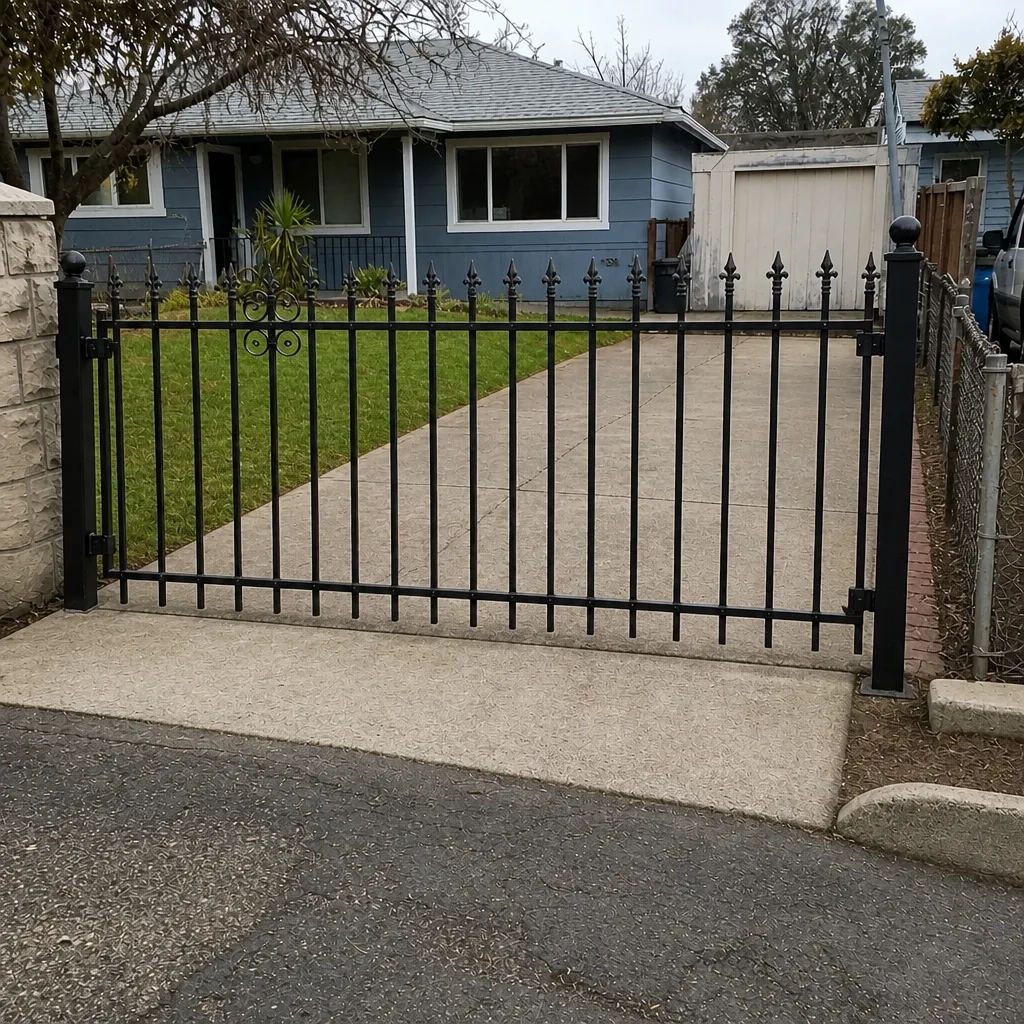 After
When to Call a Professional
Call when the gate stops moving, moves only partly, or reverses on its own even after you’ve cleaned the sensors. Call when a photo eye or safety edge won’t test properly, when you hear grinding you can’t clear with lubrication, or when hardware has frozen solid. Call when an operator trips a breaker, runs unusually hot, or shows error indications. Call if a heavy gate leaf has shifted or a post feels loose. These are all situations where forcing the gate or opening the operator yourself risks injury, voided warranty and a bigger repair than the one you started with. Gate Repair Vacaville offers free estimates in Vacaville, and we’ll tell you plainly whether you’re looking at a repair or a replacement. Call (888) 772-3933. We answer 24/7. Fast dispatch from 7am to 7pm, Sunday through Friday.
Frequently Asked Questions
Monthly for visual and safety checks, quarterly for lubrication and dust control, and annually for a professional deep inspection. Vacaville’s dry heat and dust accelerate wear beyond a national average, so the quarterly pass matters more here than the “twice a year” advice you’ll find online.
Most of the time it’s a dirty photo eye lens or debris sitting over a loop detector. Wipe the lenses, sweep the loop area and re-test. If it still reverses, the sensor alignment or the operator board needs a technician, and you shouldn’t bypass the safety device in the meantime. Call (888) 772-3933 for an exact quote on repairing it. Estimates are free.
One rated for the temperature range a Central Valley summer actually reaches, applied sparingly to hinges, pivot points and roller axles. Light sprays and general-purpose household oils thin out and dry off in valley heat. If you’re unsure what your operator maker recommends for your specific system, we can tell you when we look at it.
No. The housing holds the control board, motor and line-voltage wiring, and opening it outside trained service can void the operator warranty and carries a real shock risk. Clean the external vents and call a technician for anything inside. Our technicians have up to 10 years of experience across the major operator brands.
Mineral scaling from hard water and irrigation overspray. Wipe off what’s exposed before it hardens into a binding joint, and keep sprinkler heads back from the gate path. If hardware has already frozen, don’t force it, because binding under the operator stresses the motor and control board.
Very likely. We work on LiftMaster, FAAC, BFT, Linear, Viking, Ghost Controls, DoorKing, Elite and Mighty Mule, from entry-level residential units to professional-grade commercial access control. Our repair-first approach means we work with your existing operator rather than pushing a replacement. Call (888) 772-3933 for an exact quote. Estimates are free.
The Bottom Line
Your gate’s biggest enemy in Vacaville isn’t a storm, it’s the dry heat and dust of summer quietly wearing down lubricant, sensors and hardware. A monthly visual and safety check, a quarterly lubrication and dust pass timed to the seasons, and an annual deep inspection before the heat arrives will keep most gates opening for years. Stick to the owner-safe list, respect the six jobs that need a technician, and never bypass a safety sensor. When something’s beyond a wipe and a relube, call us and we’ll fix what’s there. If you need gate repair in Vacaville, our team can help. Call (888) 772-3933. We answer 24/7. Fast dispatch from 7am to 7pm, Sunday through Friday.
Written by the team at Gate Repair Vacaville.